Pauls Quiz 190 (Answers only)
ANSWERS
1. c. United Nations
2. c. Mexico City
3. Jerusulem
4. Music requests on the radio. DJ's were not allowed to play requests because it was feared agents and sabateurs might be able to communicate with each other.
5. Genghis Khan Genghis Khan c. 1162?1227), born Tem?jin (meaning "ironworker"), was the Mongol founder, Khan (ruler) and posthumously declared Khagan (emperor) of the Mongol Empire, the largest contiguous empire in history. He came to power by uniting many of the nomadic tribes of northeast Asia. After founding the Mongol Empire and being proclaimed "Genghis Khan", he started the Mongol invasions and raids of Kara-Khitan Khanate, Caucasus, Khwarezmid Empire, Western Xia and Jin Dynasty. During his life, the Mongol Empire eventually occupied substantial portion of Central Asia.
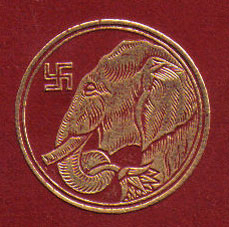 6. Kipling's 'Jungle Book' (image: see right)
7. Tatooing
8. Benjamin Franklin While his electrical work was his greatest scientific achievement, Franklin also contributed to knowledge of heat conduction, storms, the Gulf Stream, etc., and invented bifocal glasses, the rocking chair, daylight saving time, and more. He might have done more still, but after he had been working for only a few years on electricity, his country called him to other tasks. He put aside his researches reluctantly and even into his old age kept hoping to return to them.
9. After their death both had their brains removed, sliced up and preserved. Albert Einstein's brain has often been a subject of research and speculation. Einstein's brain was removed within seven hours of his death. The brain has attracted attention because of Einstein's reputation for being one of the foremost geniuses of the 20th century, and apparent regularities or irregularities in the brain have been used to support various ideas about correlations in neuroanatomy with general or mathematical intelligence. Scientific studies have suggested that regions involved in speech and language are smaller, while regions involved with numerical and spatial processing are larger. Other studies have suggested an increased number of Glial cells in Einstein's brain.
10. b. white
PaulsQuiz.com